



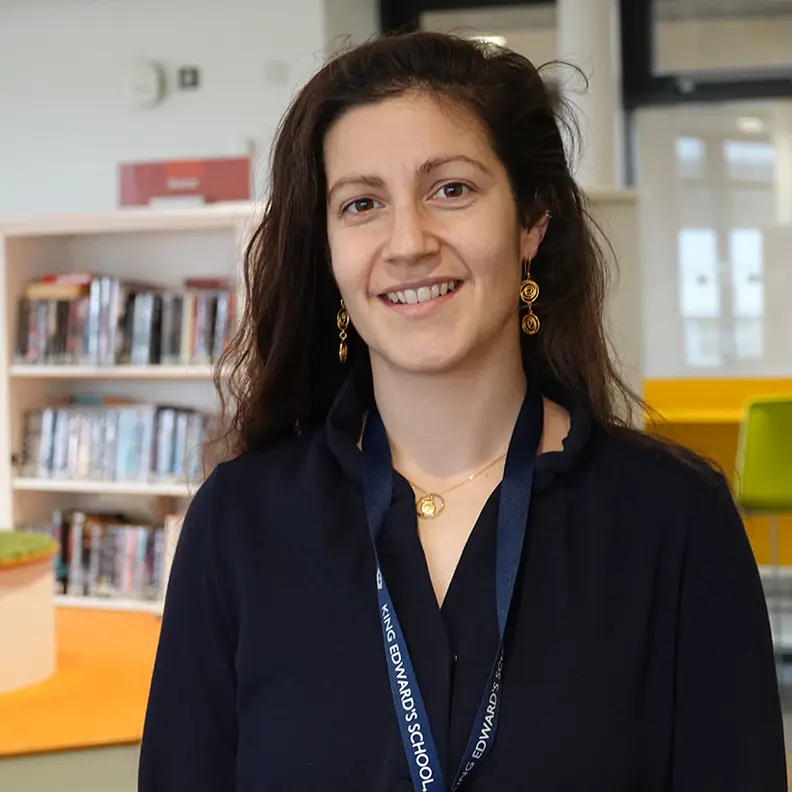
 meet ms asrari, our new librarian
Ms Asrari is our new Librarian at the Senior School. We caught up with her recently to discuss favourite reads and the role of libraries.
 What did you do before joining KES?
Something rather different! Previously, I worked for an international humanitarian organization as their Representative to the United Nations, in New York. In that job I specialised in human rights legal issues relating to adolescents, particularly girls. I worked with young activists from all over the world, advocating for their rights in some of the most challenging situations – for instance during armed conflict. So, having moved to Bath this year, it felt natural for me to take on a job that would involve lots of work with teenagers. And with a lifelong love of books, this job felt like a perfect fit.
What are you most looking forward to in your role as librarian at KES?
Talking to the students about books! Books have had a huge influence on the paths that I’ve taken in my own life, and I think that’s true for many people. Whether it’s reading a piece of historical fiction; a book set in another country; or something with a political message – fiction sparks our imaginations in so many interesting and perhaps unforeseen ways, and we often follow those threads to new horizons. I have already found that I get to spend lots of time with the pupils outside of their classroom hours, and I love hearing from them about what they’re reading. I’m lucky to have three fantastic Library Prefects who work with me on projects in the library and are a fabulous connection to the student body. I also enjoy the challenge of finding the next book for a pupil based on their likes. To help with that, I’ve set myself the academic task of reading some of the popular books in genres that I am less familiar with – although I haven’t worked my way around to picking up a horror book yet…
What is your favourite opening sentence or ending of a book?
I think it’s hard to beat the opening of Moby Dick: “Call me Ishmael. Some years ago--never mind how long precisely--having little or no money in my purse, and nothing particular to interest me on shore, I thought I would sail about a little and see the watery part of the world.” Doesn’t it just make you want to read on?
What new or recently published books have caught your eye and will soon be on the library shelves at KES?
Well, the Booker prize was awarded in November, and I always like to keep an eye on the big literary prizes. Alongside the winner, David Szalay’s Flesh, I’ll also be bringing in Kiran Desai’s entry – The Loneliness of Sonia and Sunny – which is a story about two young people navigating the various forces that shape their lives.
I am also developing the non-fiction collection, with a focus on books that will support students in exploring their interests around key academic subjects, as well as those that help students to navigate the complexities of the world outside of their school pursuits. Two books on my radar this year are The Message, by journalist Ta-Nehisi Coates – which discusses what drives people to violence, focusing on three ongoing conflicts; and The
New Age of Sexism: How the AI Revolution is Reinventing Misogyny by Laura Bates – which explores the relationship between new technologies and gender inequality.
Complete this sentence: A library should be…
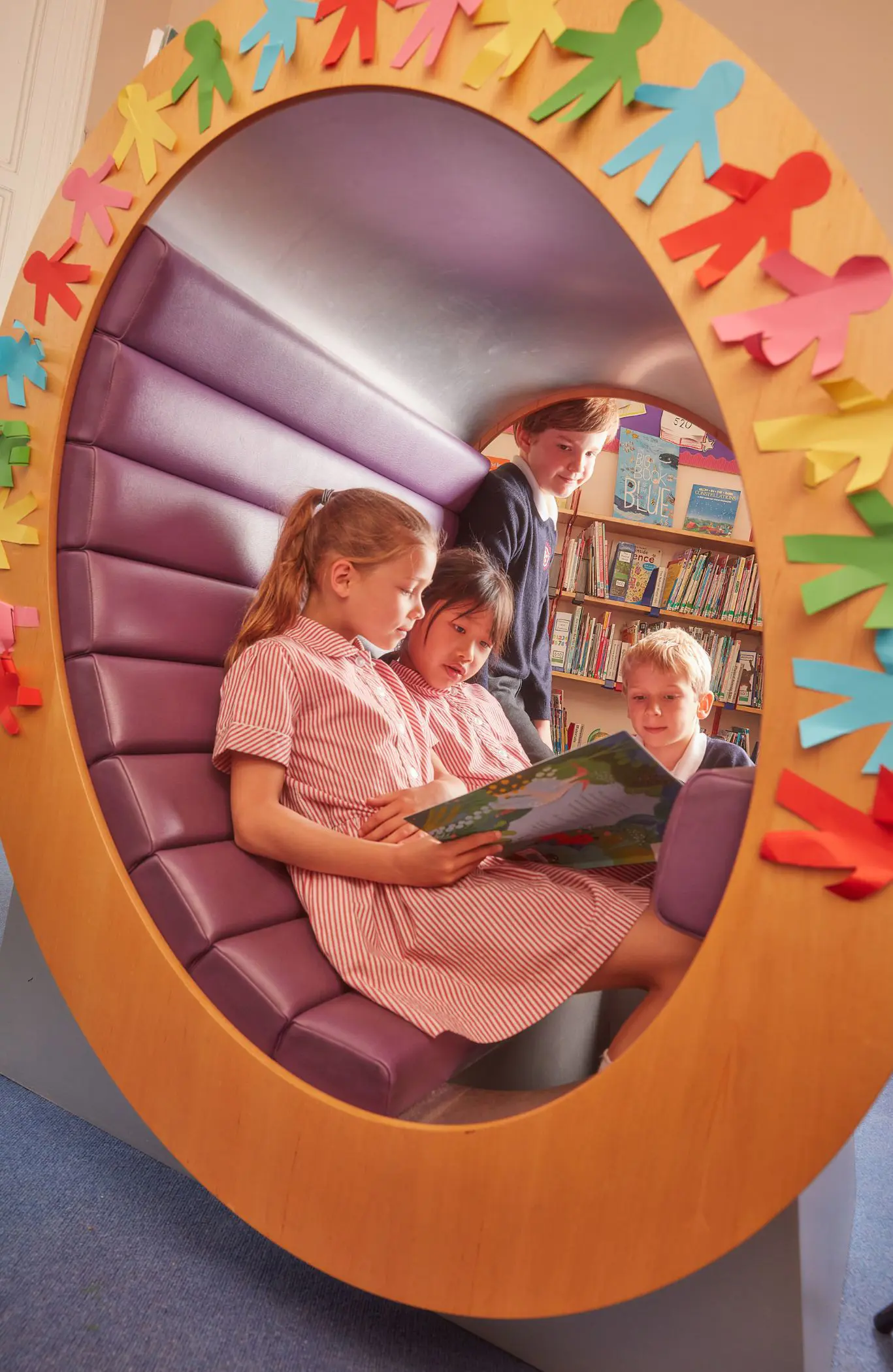
…Inviting! It should be an inclusive space where every student feels welcome, no matter what their interests are. It should have plenty of cosy corners where students can lose themselves in a book. The shelves should display their wares well, drawing readers into new subjects – libraries can learn a lot from bookshops in that respect.
Students should also feel supported in the library, receiving the help they need to find what they’re looking for – a big focus of my role. And finally, a library should be calm – a haven away from the hustle and bustle of everyday. I think that’s needed now, more than ever, as young people have much less time without external stimuli to simply think.
What 10 books would you recommend reading before leaving school?
January will see the release of KES’ Co-Curricular Reading Lists, which recommend books across all subjects for each year group. These will be key reference materials for all students when selecting their personal reading materials. I won’t cover the same ground here, instead I’m selecting 10 books which have influenced me, and which I think are important for the personal development of our students:
- The Catcher in the Rye by J.D. Salinger: Holden Caulfield is expelled from school and goes on a journey of self-discovery. This book captures teen disillusionment perfectly.
- We Should All be Feminists by Chimamanda Ngozie Adichie: An important and accessible essay, demystifying feminism and arguing eruditely for social, political and economic equality between the sexes.
- The Handmaid’s Tale by Margaret Atwood: Set in a totalitarian theocracy in which fertile women called "Handmaids" are forced into sexual servitude to bear children for the ruling elite. Dystopian fiction at its finest, and scariest.
- Siddhartha by Herman Hesse: A young Brahman in ancient India seeks enlightenment and abandons his privileged life. The story emphasizes that true wisdom comes from personal experience rather than teachings or ritual.
- Long Walk to Freedom by Nelson Mandela: Students today can take a great number of lessons from Mandela’s life and moral leadership.
- Breakfast of Champions by Kurt Vonnegut: a superb example of metafiction, satire and the absurd. It feels subversive, and is still unique and relevant, 50 years after its publication.
- The Hobbit by J.R.R. Tolkein: some of the best escapism ever written. For when we need a little hopefulness in our lives!
- Jane Eyre by Charlotte Bronte, and Wide Sargasso Sea by Jean Rhys: Students can get so much more from reading these two books together. Jane Eyre is one of the finest examples of 19th Century literature, and Wide Sargasso Sea is an excellent introduction to post-colonial literature – a prequel to Jane Eyre which tells the story of Bertha Mason, Rochdale’s mentally ill first wife who is locked in the attic.
- Mornings in Jenin by Susan Abulhawa: A book that spans three generations of a Palestinian family living through war and oppression. Students care deeply about the ongoing conflicts in this region, but it’s difficult to access unbiased information. In such an extremely politicised context, fiction can be a powerful humanising tool.
- Shogun by James Clavel. This is an excellent adventure novel, taking the reader into another world and time, with a side lesson in a lesser-taught area of history, and an examination of cultural differences. But mostly it’s a real page turner!