







 Holocaust memorial day at kes
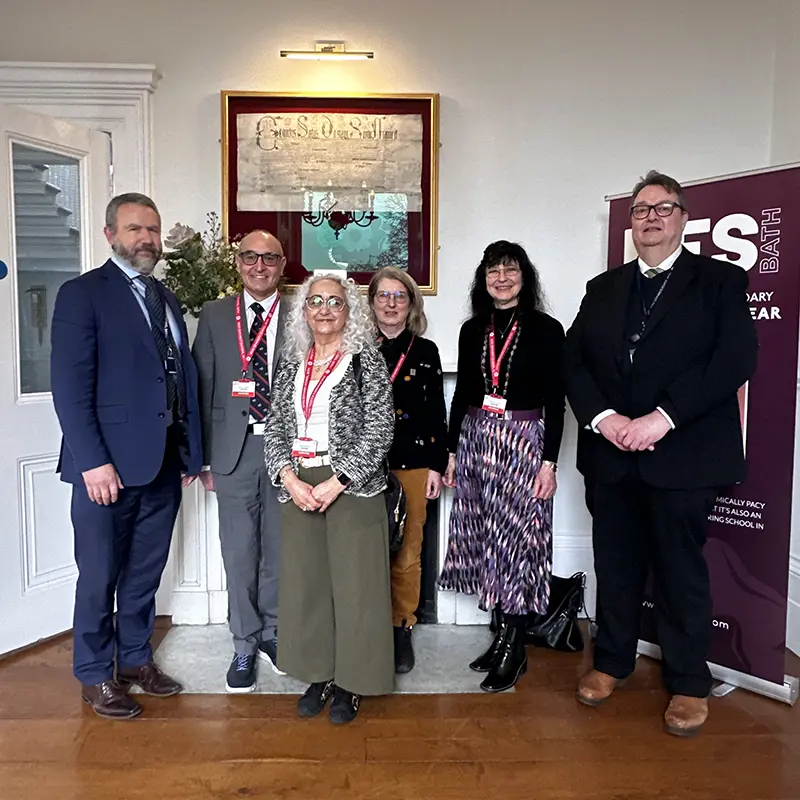 Last week, the Senior School came together to mark Holocaust Memorial Day on 27 January, a moment each year when we pause to remember the six million Jews murdered in the Holocaust, alongside others who were killed or affected by Nazi persecution. At KES, this act of remembrance is paired with deliberate learning, encouraging pupils not only to understand the events of the past, but to consider what those events ask of us today.
On 26th January, Year 9 took part in a Holocaust themed learning day, approaching the topic from both historical and philosophical perspectives.
In History, pupils traced the rise of antisemitism in Germany from the end of the First World War to the implementation of the Final Solution.
In RS, pupils explored the problem of evil and suffering in the context of Judaism, considering both traditional and modern Jewish Theodicies as responses.
The day culminated in a visit from Bryan Huberman, son of Holocaust survivor Alfred (Abram) Huberman, and a second generation speaker from the 45 Aid Society. Bryan shared his father’s story, conveying both the unimaginable hardships Alfred endured during World War 2 and the remarkable strength with which he rebuilt his life in Britain.
Pupils also learned that small acts of kindness, such as a kitchen worker at a concentration camp saving scraps of food or strangers quietly offering bread during the death march Alfred was forced to undertake, were sometimes the difference between life and death.
A Senior School Assembly the following day, on Holocaust Memorial Day itself, reflected further on Alfred Huberman’s place in history.
Returning to the story that Year 9 had heard the day before, the Headmaster spoke about the life of Alfred Huberman, from his childhood in Puławy in Poland, through multiple labour and concentration camps such as Buchenwald and Theresiendstadt. When Alfred was liberated in 1945, he discovered that only he and one sister had survived from a family of more than fifty.
The Headmaster went on to recount the little-known story of the Windermere Children, 732 young survivors brought to Britain to begin rebuilding their lives. Among them was Alfred, who arrived in the Lake District in August 1945. It was, he recalls, like moving to “paradise.”
Alfred’s experiences, preserved today through his testimony and the work of his family, continue to offer powerful lessons about humanity for a world in wich millions are still victims of marginisation and persecution. His story, though marked by profound loss, is also one of resilience and hope and moments of compassion in the face of incomprehensible evil.
As his son, Bryan, reminded pupils the day before, the stories of the Windermere Children, of Alfred Huberman, and of so many others, started with prejudice, intolerance and discrimination, and that silence and obedience in the face of hatred and lies can have terrible consequences. He also emphasised how doing the right thing, offering kindness and compassion and above all acting purposefully and positively when the circumstances demand it, can leave its own powerful legacy.